
Marketing to Past Guests: How to Collect Emails, Get Consent, and Win Repeat Direct Bookings

Every host is sitting on the same underused asset: the guests who already stayed, already liked the place, and already know what they're getting. Reaching them costs nothing compared with paying commission to meet a stranger. Yet almost nobody does it — because the OTA that sent the guest deliberately stands between you and them, and because the rules about contacting people are stricter than most hosts assume.
This guide covers the part most articles skip: getting a real contact address, with provable consent, without breaking your OTA's rules or your country's marketing laws. Then what to actually send, and how to run it without a spreadsheet.
Why the OTA inbox is a dead end
The addresses you already hold for OTA guests mostly aren't addresses.
Airbnb and Booking.com both mask guest email behind a relay. What lands in your property management system is usually a generated placeholder — something like ota_8f3c…@ota.guest — not a mailbox the guest reads. It works for booking-related messages routed through the platform, and for nothing else. Send a promotion to it and, at best, it vanishes.
The rules matter as much as the plumbing. Both platforms restrict taking communication or bookings off-platform, and Airbnb in particular treats soliciting direct bookings from guests it introduced as a serious violation — hosts in industry forums consistently report suspension as the consequence, not a warning. Booking.com masks addresses and requires signup URLs to be whitelisted in its Extranet before you can even link out. Vrbo and your own direct bookings are the easier ground, because you get a real address as part of the reservation.
The distinction that matters, and the one worth internalising:
- Circumventing the platform — pushing a guest who found you on Airbnb to book direct instead, before or during the stay — is against the rules and risks your account.
- Building your own opted-in list — a guest choosing, on your property or on your own website, to hear from you — is your relationship, and is what every serious operator does.
The first is a shortcut that eventually costs you the listing. The second is a business asset that compounds every season.
Consent is the whole game
This is the part hosts skip and later regret. In most of the world, emailing or texting someone a promotion without their consent isn't just poor manners — it's illegal.
- Email is governed by CAN-SPAM in the US, GDPR in the EU and UK, PDPA in Singapore and Malaysia, and similar regimes elsewhere. The consistent requirements: a lawful basis or consent to contact, honest sender identity and subject lines, a physical postal address, and a working one-click way to stop hearing from you.
- SMS and WhatsApp are stricter still. US TCPA rules around texting carry real per-message penalties, and WhatsApp's Business Platform requires explicit opt-in captured before you send, with template messages approved in advance for anything promotional. Treat messaging as a higher bar than email, not a casual alternative.
What "consent" needs to look like in practice is unglamorous but simple: the guest actively agreed — a ticked box they ticked themselves, not a pre-ticked one — to a clearly worded statement, and you can show when and how they agreed. "They stayed with us, so they're a customer" is not consent for marketing in a GDPR jurisdiction.
Wording that does the job, next to an unticked checkbox:
Send me occasional offers and news about staying here. No more than a few emails a year, and you can unsubscribe any time.
Specific, honest about frequency, and it names the exit. That single sentence is the difference between a list you own and a liability.
(This is practical guidance from operating experience, not legal advice — the rules differ by country and change. If you're marketing across borders, get your wording checked once, properly.)
Four ways to collect a real address, with consent
1. WiFi splash page. The highest-yield method by a distance. Guests connect to the network, land on a branded page, and enter an email with a consent checkbox to get online. Tools like StayFi exist for exactly this. It captures everyone in the party, not only the booker — which is why operators using it report collection rates far above every other method. A four-person booking becomes four opted-in contacts, three of whom the OTA never knew about.
2. Digital guidebook or guest portal. If your check-in information, door codes, WiFi password and local recommendations live behind a link, that link can ask for an email first. The trade is fair and obvious: the guest gets everything they need for the stay in one place. Keep the consent checkbox separate from access — gating the door code behind a marketing opt-in is coercive and, in a GDPR jurisdiction, invalidates the consent you just collected.
3. The check-in flow itself. If you already collect guest details for registration, ID verification, or a rental agreement, you have a lawful, expected moment where a guest is filling in a form. Add the marketing opt-in there as a clearly separate choice.
4. Post-stay, on your own channel. A thank-you message sent through the platform, pointing at your own site — a review request, a local guide, a returning-guest page — is compliant, because you're not soliciting off-platform booking; you're offering something on your own property. Guests who sign up there are the warmest names on your list.
What all four have in common: the guest acts. Nothing is harvested, nothing is assumed.
What to actually send
A list you never mail is as useless as no list. But the failure mode in this business isn't sending too little — it's sending a generic newsletter nobody opens. Three messages do almost all the work:
The thank-you, two to three days after checkout. No offer. Thank them, ask for the review if you haven't already, mention that returning guests book direct. This message exists to establish that email from you is pleasant and infrequent.
The seasonal offer, timed to your booking window. Not "10% off" sprayed in January — an offer that lands when someone would actually plan that trip. If your shoulder season books eight weeks out, send it nine weeks out. Reference where they stayed and when; a message that knows they were in the beach house last March is a different message from a mailshot.
The win-back, at six to twelve months. Guests who stayed once and haven't returned are the biggest segment in most guest books and the most responsive to a genuine reason to come back — a new property, a refurbished space, a quiet-season rate.
The thank-you doesn't need a human to remember it. Lifecycle messages — booking confirmed, check-in instructions, mid-stay check-in, post-checkout — run as scheduled automations against reservation events, so the post-stay note goes out on time whether or not anyone is at a desk:
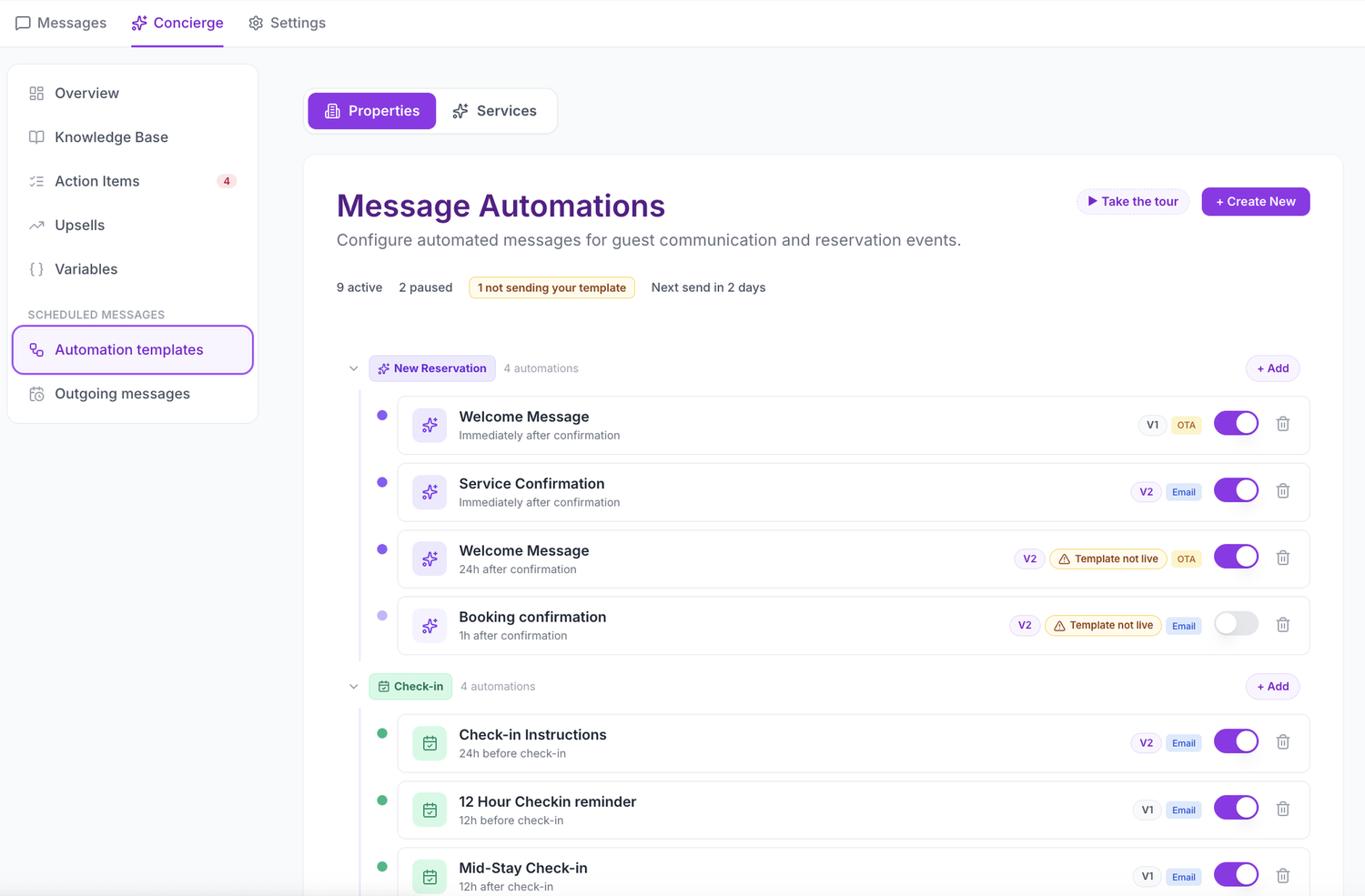
Note the channel badge on each automation. Messages tied to a live reservation ride the OTA thread, which is where they belong; the ones that reach a guest's own inbox are the ones that need an address you collected.
Two rules hold across all three. Give returning guests a real reason to book direct — a better rate, a later checkout, a free upgrade — because "book direct" is a request, not an offer. And keep frequency low: a few emails a year from someone whose house you enjoyed is welcome, monthly is spam.
Running it in SympleHost
Guest Campaigns is built for exactly this, and it runs on the guest history the platform already holds, so there's no list to export or maintain.
Build the audience from what guests actually did. Rather than one undifferentiated list, you pick a preset: top spenders, frequent stayers, guests who haven't stayed in six months, guests who stayed at a specific property, or best rated — or hand-pick guests yourself. The three ranking presets return your top 100, so "top spenders" means your hundred best guests, not your whole guest book with a sort applied.
See who is genuinely reachable before you write anything. This is the step that matters given everything above. The audience preview splits your selection into who can be contacted and who can't, and tells you why — no email address on file, or previously opted out. It's an honest count, and on an OTA-heavy account it is usually humbling: it's the number that tells you how much collecting you still have to do.
Drafts are generated per recipient, and you approve them. Each message is written for that guest and their stay, in the angle you choose — an invitation back, a thank-you with an offer, or a personal note. Nothing sends until you've read the list. Personalised at scale is the point; automated-and-unread is not.
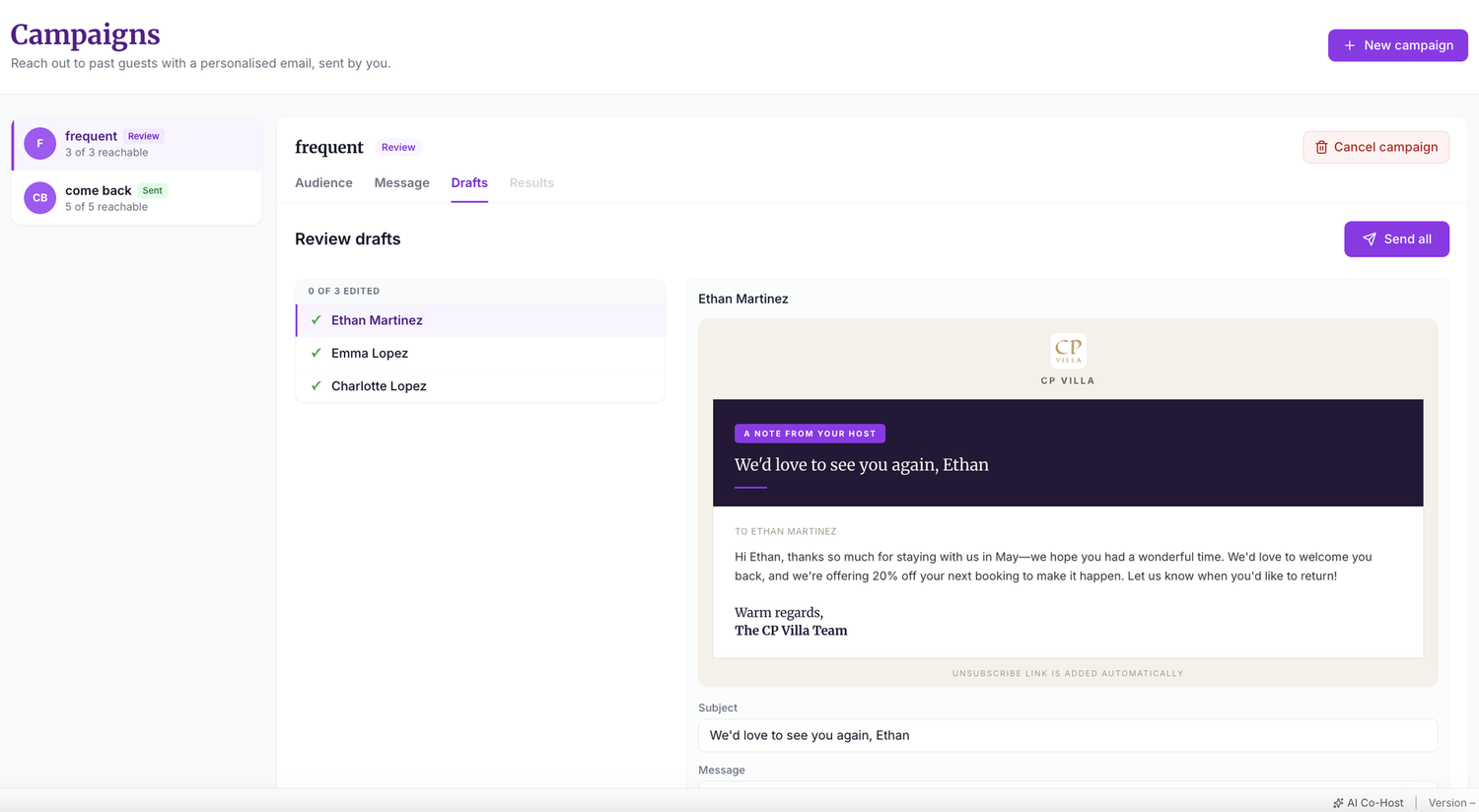
Three things worth noticing in that screen: the campaign says "3 of 3 reachable" before anything is written, each guest has their own draft rather than one mail merged five ways, and the footer notes that the unsubscribe link is added for you.
Compliance is handled by default. Every campaign email carries an unsubscribe link, opt-outs are honoured automatically and permanently, and a 30-day suppression window stops the same guest being mailed twice in quick succession by two different campaigns.
One honest limitation: campaigns are email only today. WhatsApp is where SympleHost handles two-way guest conversations — the unified inbox threads WhatsApp, Instagram, Facebook and the OTA inboxes together — but bulk promotional messaging over WhatsApp is not a campaign channel yet. Given how strict WhatsApp's promotional-template rules are, email is the right place to start regardless.
The order to do this in
If you're starting from zero, resist the urge to write a campaign first. The sequence that works:
- Put collection in place — WiFi splash page or guidebook gate, with a real consent checkbox. Nothing else matters until addresses start arriving.
- Let it run for a season. A list of 40 real, opted-in guests outperforms 400 placeholder addresses, and you'll have the first by the end of one busy quarter.
- Send the thank-you sequence to everyone who opts in, so your first real campaign isn't the first time they hear from you.
- Then run the seasonal and win-back campaigns against audience presets, and measure direct bookings — not opens.
The compounding is the point. Every season adds names you own outright, on a channel no platform can mask, rate-limit, or charge commission on.
Frequently asked questions
Can I email guests who booked through Airbnb? Not using the address Airbnb gives you — it's a masked relay, and using platform-introduced contact details to solicit direct bookings breaches Airbnb's terms and risks your account. What you can do is invite guests, on your property or through your own website, to join your list themselves. Once they've opted in, they're your contact rather than the platform's, and normal marketing law applies.
What's the best way to collect guest emails? A WiFi splash page, by a wide margin, because it captures every member of the party rather than only the person who booked. A digital guidebook that asks for an email before showing check-in details is the strong second. Both beat asking in a message, which most guests ignore.
Do I need consent to email past guests? In the EU, UK, Singapore, Malaysia and most comparable jurisdictions, yes — an active opt-in, recorded. In the US, CAN-SPAM is less strict about prior consent for email but still requires accurate headers, a postal address and a working unsubscribe. SMS is far more tightly regulated everywhere. The safe operating rule that satisfies all of them: only mail people who ticked a box, and always give them a way out.
How often should I email past guests? A few times a year. A post-stay thank-you, one or two seasonal offers timed to when people actually plan that trip, and a win-back for guests who haven't returned in six to twelve months. Frequency is what turns a welcome sender into a blocked one.
Can I send campaigns over WhatsApp? Not as bulk campaigns in SympleHost today — campaigns are email only. WhatsApp is supported for two-way guest conversations in the unified inbox. That is also the safer starting point: WhatsApp requires pre-approved templates and explicit opt-in for promotional messaging, with less room for error than email.
Related Reads
あなたの共同ホストは、眠らない。だから、あなたは眠れる。
SympleHostを14日間お試しください。カード登録が必要です。初期費用は不要、いつでもキャンセルできます。オンライン通話での初期設定サポートもご利用いただけます。