
Homestay and Villa Software for Goa (2026): What Goa Hosts Actually Need
By Shashank Udyawar, India Operator Specialist, SympleHost
Running a short-term rental like a business · November 16, 2026 · 10 min read
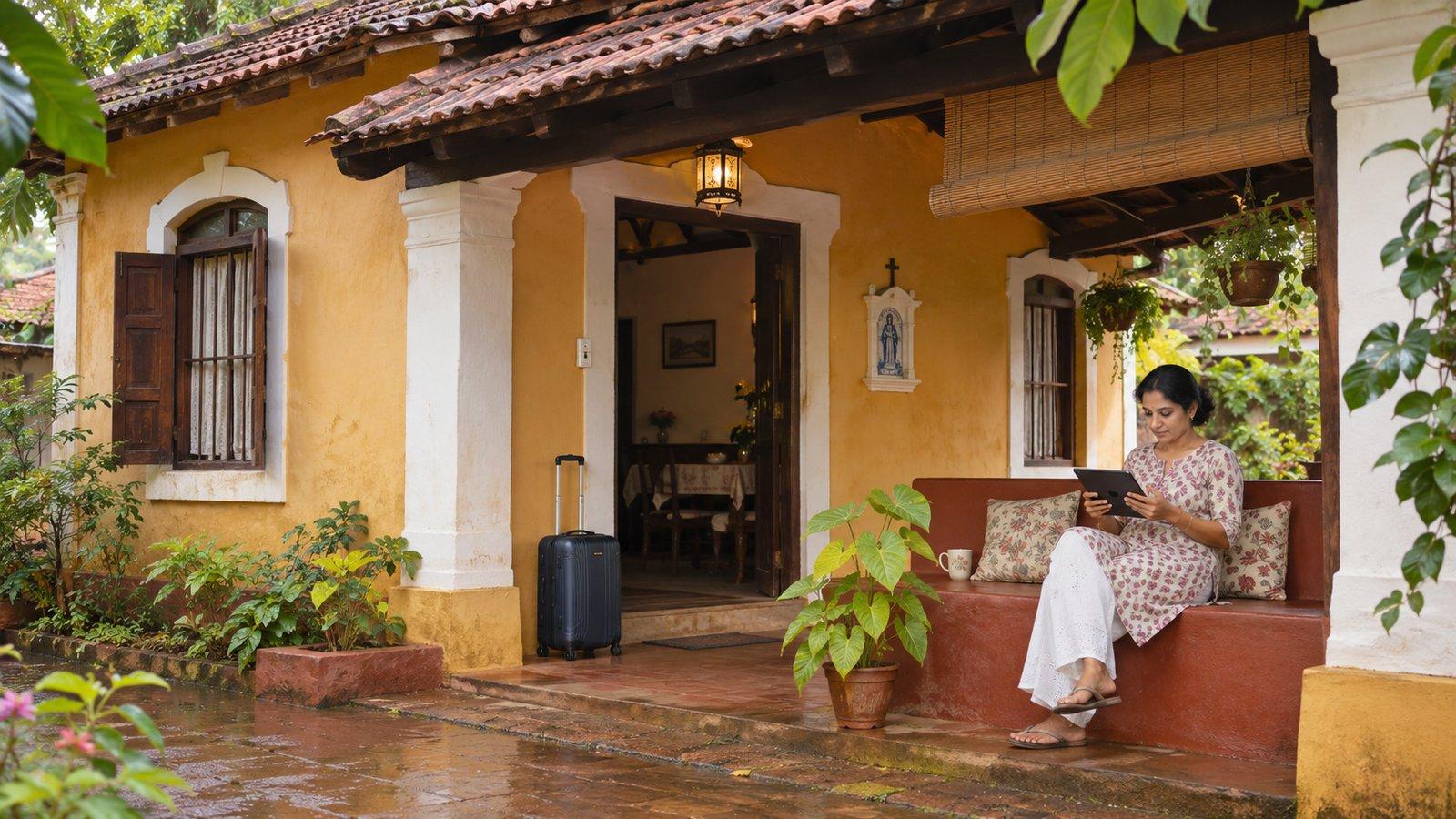
It's 20 December. You run six villas around Assagao and Anjuna and a five-room homestay in Siolim. Over the four nights from 28 to 31 December, the villas sell at about ₹22,000 a night and the homestay rooms at ₹5,500 to ₹7,000. That's roughly ₹6.5 lakh of revenue in four nights, split across Airbnb, Booking.com and MakeMyTrip, plus a few WhatsApp enquiries from repeat guests. Three of the homestay guests are foreign, so each needs a Form C within 24 hours of arrival. On 1 January all six villas turn over before lunch. And before 5 January, the Department of Tourism wants your December tourist statistics. One double-booked villa on New Year's Eve costs you ₹22,000 before any penalty. This page is about the software that keeps that week under control.
The short version
- Goa's paperwork is monthly, not once a year. Registered homestays and small units file tourist statistics (Form XI) on Goa Online before the 5th of every month, and renewal stalls until they're filed. Your software should make December's numbers easy to pull on 2 January.
- Every listing needs its Goa registration number. Airbnb asks for it on each listing, and a listing on Airbnb doesn't replace registration with the Department of Tourism.
- Form C is a 24-hour job with a ₹50,000 penalty per case. The Goa government said so in December 2025. Collect passport and visa details when the booking is confirmed, not at the gate at midnight.
- A mixed portfolio has two GST rates. A ₹22,000 villa night is taxed at 18%, a ₹6,000 homestay room at 5%. Six villas will cross the ₹20 lakh registration threshold quickly.
- The peak is about ten days long. 20 December to 2 January decides the season, so calendar sync has to be API, not calendar links, on every channel that offers it.
- Price it per listing. For this portfolio, SympleHost is ₹5,787 a month, plus GST, with no setup fee and no commission.
For the market picture (who books Goa, North vs South, growth numbers), read our Goa vacation rental market report. This page is about running the operation.
Get your Goa registration sorted before you choose software
Software can't fix a listing that shouldn't be live. Goa registers short-term accommodation under the Goa Registration of Tourist Trade Act, 1982, and the Homestay and Bed & Breakfast Scheme 2025 sits on top of it. According to Airbnb's Goa rules page:
- Category "D" covers rented or serviced apartments, bungalows, homestays and B&Bs, with one to six lettable rooms (12 beds). A three-bedroom villa and a five-room homestay both fit here.
- A homestay is one where the owner and family live on the property. If you don't live there, it's a B&B, and an operator lives on site instead.
- You apply on Goa Online, or with Form XXIII at the registration desk at Paryatan Bhavan in Panaji. The Department lists processing at 90 days.
- Mandatory documents are the trade tax or house tax receipt, proof of identity, and a Fire NOC and Housing Society NOC where they apply. If you lease the property, add the lease or a notarised NOC from the owner.
- The registration number goes on the listing. Airbnb asks you to add it in your listing settings, and can be told to remove listings that aren't compliant.
Registration fees vary by category and the published figures don't agree, so check the current fee on Goa Online rather than trusting a blog, including this one.
What matters for software: you'll have a registration number per property, and you'll owe the Department a statistics return every month. Keep both in the same place as your bookings.
The Goa compliance calendar your software has to support
| What | When | Who sees it |
|---|---|---|
| Tourist statistics (Form XI) on Goa Online | Before the 5th of the following month, every month | Department of Tourism. Renewal isn't processed until it's filed, with any penalty paid |
| Form C (now Form III) for each foreign guest | Within 24 hours of arrival at your property | Bureau of Immigration, on e-FRRO |
| Departure entry for each foreign guest | At check-out | Bureau of Immigration, on e-FRRO |
| GST return, if registered | Monthly or quarterly, as your CA sets it up | GST portal |
Form XI is the one hosts forget, because nobody outside Goa talks about it. Airbnb's Goa page says hotels and homestays in a tourist area must submit tourist statistics electronically, with a processing fee, before the 5th of the month after the one they cover. Late statistics count as a violation and hold up renewal. So the day after New Year, someone has to count December's guests, by property. If your bookings live in three OTA dashboards and a WhatsApp chat, that's an afternoon. If they live in one calendar you can export, it's twenty minutes.
Form C has its own guide: how to file Form C (FRRO) for your homestay. The Goa-specific point is the stakes. A Government of Goa notice of 10 December 2025 reminded hoteliers, guest house operators and private house owners to upload Form C within 24 hours of arrival, under the Immigration and Foreigners Act 2025, with a penalty of ₹50,000 in each case. A villa with a family of four foreign guests is four forms. Over the New Year week, the hours between arrival and deadline are exactly when your team is busiest.
GST in Goa: two rates in one portfolio
Two GST facts change how a Goa operator sets prices.
The registration threshold. Under section 22 of the CGST Act, you register once aggregate turnover in a financial year passes ₹20 lakh (the lower ₹10 lakh limit is only for special category states, and Goa isn't one). One villa at ₹15,000 a night for 140 nights is ₹21 lakh. Six villas are well past it.
The rate depends on the night's price. Since 22 September 2025, hotel accommodation priced at ₹7,500 or less per unit per day is taxed at 5% without input tax credit, and above ₹7,500 at 18%, following the 56th GST Council's recommendations. The government's FAQ says you can't opt into 18% with credit for the cheaper rooms.
In the scenario, a ₹22,000 villa night carries 18% and a ₹6,000 homestay room carries 5%. The same villa might drop under ₹7,500 in July and change slab. If you quote direct guests a tax-inclusive price over WhatsApp, the slab has to be right on every night of the stay.
How GST works on bookings that come through Airbnb, Booking.com or MakeMyTrip depends on whether you're registered, and the OTAs also deduct TDS and TCS from payouts (our India channel manager guide has the numbers). Take this part to your CA.
The ten days that decide the season
The weeks from about 20 December to 2 January carry a Goa villa's year. Christmas, New Year's Eve parties in North Goa and the school holidays all land at once, and families from Mumbai, Pune, Bengaluru and Delhi book whole villas for groups. Then the season fades through spring, and in the monsoon the sea closes: Drishti Marine, the state's lifeguard agency, advises visitors to stay out of the sea from June to September.
Three things follow for software:
- Peak-week sync has to be instant. Calendar links refresh on the booking site's schedule, often hours apart, and MakeMyTrip doesn't offer them at all. During the ten days that matter most, two families can book the same villa for 31 December inside one refresh window. Our double-booking guide walks through the first hour if it happens, and what each cancellation costs.
- Prices change by date, not by month. A ₹22,000 night on 31 December might be ₹12,000 on 5 January and ₹6,000 in August. You need date-level pricing, minimum stays for the peak (many villas set three or four nights over New Year), and one place to change them for every channel.
- The monsoon is when you fix things. It's the quiet time to move channels, rebuild listings and train staff. Don't switch systems on 15 December.
Villas and homestays sell differently
A Goa portfolio usually mixes two shapes, and your software has to handle both.
Villas are sold whole. A three-bedroom villa in Assagao is one booking for one group. It's one listing with one calendar. Domestic families booking a group trip often start on MakeMyTrip, where prices are set per guest count rather than one nightly price, so the software has to translate an Airbnb-style price into MakeMyTrip occupancy rates. If it can't, you undercharge the group of eight.
Homestay rooms are sold by the room. If three of the five rooms are identical, list them as one room type with three units on every channel. Then one booking closes one room, not the whole homestay. Map them differently on two channels and the counts drift, which is how the same room sells twice.
Some villas are sold both ways. A four-bedroom villa that goes whole over New Year but room by room in the shoulder season is the hardest case. A whole-villa booking has to close every room, and a single-room booking has to close the whole villa. Ask any vendor to show you this working on your own villa before you sign up, including us.
What to look for in software for Goa
Use this as a checklist when you compare tools.
- API connections to Airbnb, Booking.com and MakeMyTrip. MakeMyTrip should cover Goibibo through the same connection. Calendar links are a fallback for small sites, not for your main channels.
- MakeMyTrip occupancy pricing. One base price and an extra-guest price should become a price for every guest count.
- Room types with units. Your homestay's identical rooms should be one room type with a unit count, the same on every channel.
- Date-level pricing and minimum stays, set once and pushed everywhere, for the 20 December to 2 January peak.
- A record of who's foreign before they arrive. Guest ID verification sent with the booking, and a fast way to open e-FRRO from the booking.
- Arrival tracking. Form C's 24 hours start at arrival. Your staff should be able to mark a guest as arrived, so you know whose clock is running.
- An export of the month's bookings, by property, so Form XI before the 5th is a short job.
- GST slabs on direct bookings. 5% up to ₹7,500 a night and 18% above, worked out night by night.
- Cleaning tasks from every checkout. On 1 January, six villas turn over at once.
- Two-way WhatsApp in the same inbox as OTA messages. Repeat guests in Goa book on WhatsApp, and you don't want a second phone for it.
- Rupee pricing with no commission. A tool that takes a percentage of bookings takes it hardest in your best week.
- A plan that grows with you. If you'll be at 15 or 25 units in two years, check what the bill looks like then.
Where SympleHost fits
SympleHost is a property management system with the channel manager built in. Here's how it lines up against that checklist, including where it stops.
- Channels. Airbnb, Booking.com, MakeMyTrip (which also covers Goibibo), Agoda, Expedia, Trip.com and Vrbo connect by API through Channex, an approved connectivity partner. Traveloka and Tiket.com are available on request. Other sites can still connect by calendar link.
- MakeMyTrip occupancy pricing. Set a base price and an extra-guest price, and SympleHost sends MakeMyTrip a price for every guest count.
- Room types and units. Your three identical homestay rooms are one room type with three units. If a booking lands on a night that's already sold out, you get an email and an in-app overbooking alert with the listing and dates.
- Form C support, not filing. A QID verification request goes out with the booking, staff mark guests as arrived on the booking card, and a Fill Form-C link opens the e-FRRO form page. You still log in and submit the form yourself. SympleHost isn't connected to the FRRO system.
- Form XI. SympleHost doesn't file Form XI. You can export the month's reservations as a CSV from financial reports and work from that.
- GST on direct bookings. An India GST preset (Settings, then Direct bookings, then Fees & taxes) applies 5% to nights up to ₹7,500 and 18% above, night by night.
- Operations. A cleaning task from every checkout, one inbox for guest messages from every channel with two-way WhatsApp, and direct bookings with Razorpay.
- Pricing. If you use dynamic pricing, PriceLabs connects to your own PriceLabs account, which you pay PriceLabs for directly.
What the scenario portfolio costs. Prices come from our India pricing page: ₹599 per listing a month (each villa or room type is one listing), and ₹199 a month for each unit in a room type with two or more units, plus GST. Say the homestay's five rooms are two room types: three identical doubles and two family rooms. Then:
| SympleHost | |
|---|---|
| 6 villas (6 listings) | 6 × ₹599 = ₹3,594 |
| Homestay (2 room types, 2 listings) | 2 × ₹599 = ₹1,198 |
| Homestay units (3 + 2 = 5) | 5 × ₹199 = ₹995 |
| Per month, before GST | ₹5,787 |
| Yearly (10 months charged for 12) | ₹57,870 |
That's less than one New Year villa night (₹22,000) for a quarter. If all five homestay rooms are different, they're five single-unit room types instead: 11 listings with no unit charge, so it's 11 × ₹599 = ₹6,589 a month.
As you grow, every listing stays at ₹599. At 25 villas, that's 25 × ₹599 = ₹14,975 a month, plus GST. There's no setup fee and no commission on your bookings. Payment gateways, including Razorpay, are included.
Start a 14-day free trial, ideally well before mid-December, or book a call and we'll check your room-type mapping and your whole-villa setup with you.
Frequently asked questions
Do I need to register my Goa homestay or villa with the Department of Tourism? Yes. Goa registers short-term accommodation under the Goa Registration of Tourist Trade Act, 1982 and the Homestay and Bed & Breakfast Scheme 2025. Category "D" covers apartments, bungalows, homestays and B&Bs with one to six lettable rooms (12 beds). Apply on Goa Online and add the registration number to each listing. An Airbnb listing doesn't replace registration.
What is Form XI for Goa homestays? It's the monthly tourist statistics return. Registered hotels and homestays in a tourist area submit it electronically on Goa Online, with a processing fee, before the 5th of the following month. Late returns count as a violation and hold up renewal.
What is the penalty for not filing Form C in Goa? A Government of Goa notice of 10 December 2025 put it at ₹50,000 in each case under the Immigration and Foreigners Act 2025. Form C (now Form III) is due within 24 hours of a foreign guest's arrival, one form per guest.
What GST rate applies to a Goa villa? Since 22 September 2025, accommodation at ₹7,500 or less per unit per day is taxed at 5% without input tax credit, and above ₹7,500 at 18%. A villa at ₹22,000 a night is in the 18% slab. You must register for GST once turnover passes ₹20 lakh a year. Check how OTA bookings are treated with your CA.
Can one tool manage both my villas and my homestay rooms? Yes, if it handles room types with units. Each villa is a single-unit listing. Identical homestay rooms become one room type with a unit count, so one booking closes one room. If you sell a villa both whole and by the room, ask the vendor to show you it working on your own villa first.
How much does SympleHost cost for six villas and a five-room homestay? With the homestay set up as two room types (five units), it's ₹5,787 a month, plus GST. Yearly billing charges 10 months for 12. There's no setup fee and no commission on bookings.
Related Reads
- Goa's Airbnb and Vacation Rental Market in 2026
- How to File Form C (FRRO) for Your Homestay: 2026 Guide
- Channel Manager for India (2026): Sync Airbnb, Booking.com, MakeMyTrip and Goibibo
- Double Booked on Airbnb and Booking.com in India? What to Do in the First Hour
- Best Airbnb Management Software in India (2026)
Sources: Airbnb: Goa rules for hosts · Government of Goa: Online filling of C-Forms under new immigration law (10 December 2025) · PIB: Recommendations of the 56th GST Council · PIB: FAQs on the 56th GST Council decisions · CBIC: CGST Act, 2017 · Drishti Marine monsoon advisory, via India Blooms. Registration fees, forms and tax rates change, so confirm with the Department of Tourism, your local FRRO and your CA. The villa and homestay rates in the scenario are illustrative.
Built for Indian property managers.
Start your 14-day trial — business email and card required, cancel anytime. Or book a call and we will wire MakeMyTrip, WhatsApp, and your first properties with you.