The commission you don't see
OTAs take 15–25% per booking. On a portfolio doing $15,000 a month across five properties, that's $27,000 to $45,000 a year going to platforms you don't control.
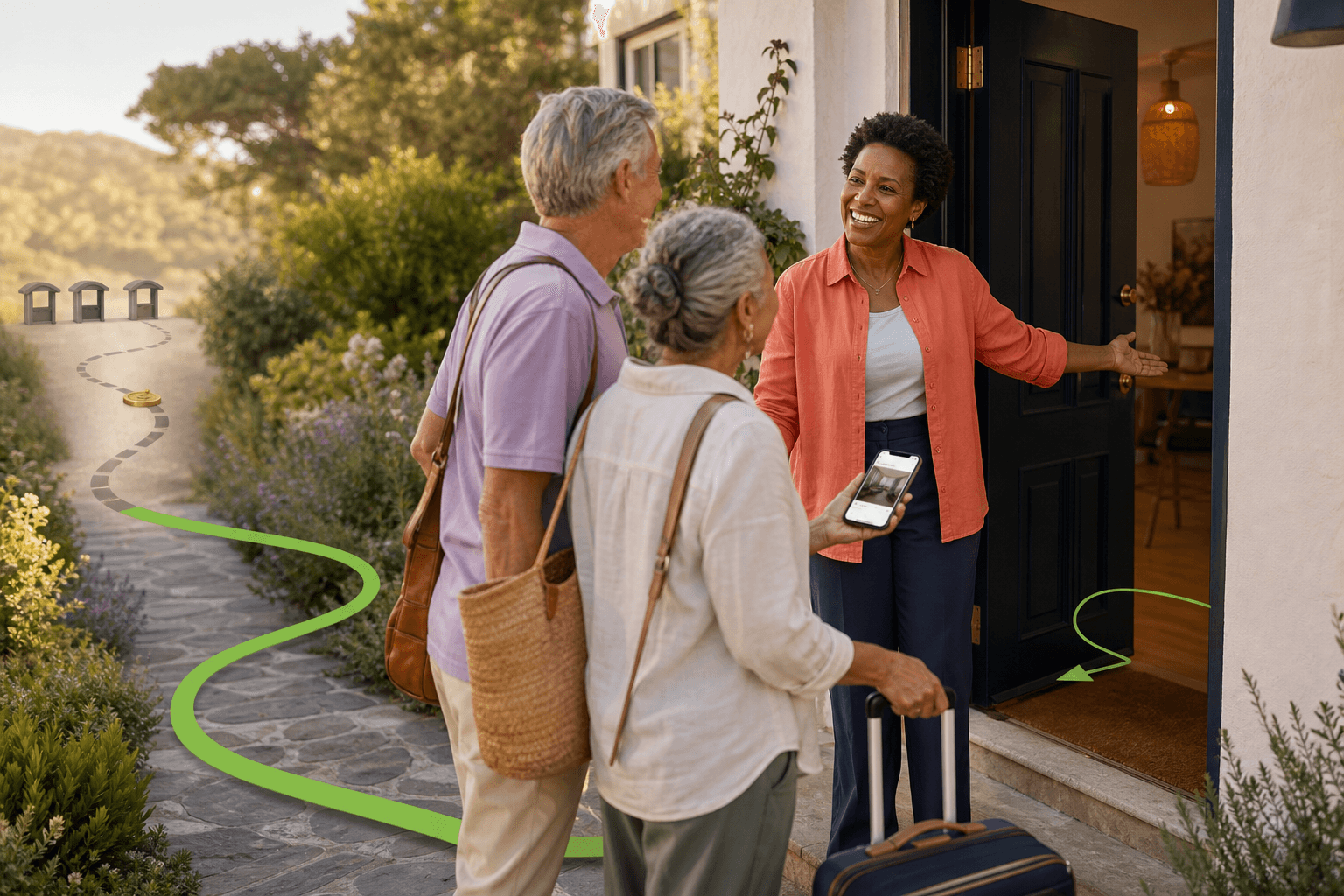
Direct booking isn't about leaving Airbnb. It's about not paying a finder's fee on a guest you already met. The OTA earned the first booking. It didn't earn the third.
The math, on one booking
A guest books an $800 stay through Airbnb. They pay roughly $912 with the guest service fee. You net about $776 after the host fee.
The same guest books direct next time at $750. After roughly 3% in payment processing, you net about $728 — and the guest still paid $162 less than they would have on the OTA. Everyone is better off except the platform.
Now stretch that across a relationship. A guest who rebooks direct generates 25–40% more profit over their lifetime than one who keeps coming back through an OTA. The first booking is acquisition. Every one after that is margin you're choosing to give away.
The four-stage funnel
You don't convert a guest to direct with a discount code on the fridge. You move them through four stages.
Stage 1 — Discovery (let the OTA do its job). A new guest finds you on Airbnb, Booking, or Expedia. Don't fight this. Optimize the listing, chase reviews, win the search ranking. The OTA is the best top-of-funnel you'll ever have. Use it.
Stage 2 — In-stay (move the conversation off-platform). Send a real welcome message over WhatsApp, not the OTA inbox. Be genuinely useful — directions, the good coffee, the beach that isn't on the map. Somewhere in the stay, one low-key line: "Book direct next time at [your domain] and skip the fees." Said once, helpfully, not stamped on every surface.
Stage 3 — Post-stay (build the relationship you already have). Thank them off-platform. Record what you learned: who they are, when they came, what they liked. Four to six weeks before your next peak — Queenstown's ski season, Tulum's dry season, Byron Bay's summer — reach out with a specific offer to people who already know your place is worth it.
Stage 4 — Direct rebooking (make it easier than the OTA). This is where most operators lose. Your booking page has to load in under three seconds and take under two minutes to complete, on a phone. Most of your guests will book from a phone, often from bed. If your direct option is slower than the app they already have, they'll use the app. Offer a quotation flow for the guests who'd rather just message you and pay, the way they did the first time.
The asset you're actually building
Track three numbers: direct booking share (15–20% in year one is healthy, 30–40% by year three), repeat rate (aim for 20–30% within two years), and how fast your guest list is growing.
That last one matters most. The OTA owns its audience. Your direct list — the guests, the emails, the relationships — is the one marketing asset that's yours, doesn't get more expensive every year, and can't change its terms on you next quarter.
A direct-booking site, a guest CRM, and the messaging to run the funnel are all part of SympleHost — one product, not a $99/month add-on. But the strategy works on any stack. The point isn't the tooling. It's deciding the third booking belongs to you.
Your co-host never sleeps. So you can.
Try SympleHost for 14 days — card required, no setup fee, cancel anytime. Or have us set it up with you on a call.